
Knoxville Resident Lookup Sources
A name is only the starting point for a Knoxville name search. Knox County systems and Tennessee agencies keep separate indexes for separate purposes. KGIS and the Assessor can connect a name to a parcel or owner label, but an owner, grantee, taxpayer, mailing addressee, and occupant are different roles. The voter service checks registration information. Court indexes identify a party and court role. Vital-record applications have strict entitlement rules. Older newspapers and archival material can place a person in Knoxville at a particular time, but they are historical evidence, not current-location proof.
| Record | What it can confirm | Official route | Access boundary |
|---|---|---|---|
| Parcel or assessment entry | Parcel context and an owner label | KGIS and Knox County Assessor | Public convenience data, not title or occupancy proof |
| Registration verification | A registration lookup lead | GoVoteTN | Exact-card matching and protected records apply |
| Local court party index | Party role, court, case identifier, and date filters | JIMS | Coverage and image availability vary |
| Vital certificate | An authorized event record or an older public record | Tennessee Vital Records | Recent records need entitlement and identification |
| Historical obituary or directory | Dated family or place context | McClung Collection | Verify against a primary source when needed |
Choose the route by the question. Start with KGIS only when a parcel is relevant. Use the voter service for registration verification, not political identity. Use a court portal for a court matter, and use a vital-record office only when the requester has a lawful certificate need. That separation prevents a weak name match from becoming a false profile.
Knoxville Court Lookup Paths
JIMS is the local party-search route for Fourth Circuit and General Sessions matters. Its observed controls are Last Name, First Name, and Case Title, plus role choices for Attorney, Defendant, Plaintiff, and Judge. Court choices include All, Fourth Circuit, and General Sessions, while Opened After and Opened Before narrow a search. The visible behavior supports prefix matching for names and contains matching for a case title. At least one text field is required. Record the party role and court with every result.
For civil documents, the Knox Circuit Clerk eCommerce search is a separate route. It has Circuit 1, Circuit 2, and Circuit 3 Civil Sessions tabs, docket-number search, image access, and register or login controls. Knoxville Municipal Court handles city citations and ordinance matters, while Tennessee Public Case History is the appellate route. Federal cases belong with the Eastern District of Tennessee and PACER. These systems are not one database, so a no-result in one does not close the question in another.
For a view of the civil route, use the Circuit Clerk search shown here.
The portal separates civil sessions and its result tools, which is why the court division and docket number belong in any research note.
Note: A charge, warrant, arrest entry, or docket event is not a conviction unless the record itself shows a judgment or disposition.
Checking a Knoxville Resident
Use a deliberate sequence to look up a resident with a common name. Begin with a non-sensitive anchor, such as a known city, court division, approximate date, historical edition, or parcel number. Compare name variants in the correct official system. The research record should preserve the source URL, date checked, jurisdiction, returned role, and any record number. Do not combine results merely because a first and last name match. A parcel card may have an assessor owner label, while a court row may identify a plaintiff or defendant and a directory entry may be decades old.
- Identify the record category first: parcel, registration, court, vital, obituary, or archive. Use the official portal for that category.
- For a court search, enter the known name variation and add role, court, or filing-date limits when the portal offers them. Save the case number and court rather than a bare name.
- Compare a second, non-sensitive point such as jurisdiction, date, parcel, or historical address. If the information conflicts, retain both source-specific results instead of choosing one.
- Request a certified copy from the clerk or custodian only when a certified record is actually needed and the access rule allows it.
- Docket
- A court’s running list of filings, hearings, and other case events. It does not by itself establish the outcome.
- Index and image
- An index points to a record. An image is a view of the document and can have different access limits or fees.
- Certified copy
- A copy issued or certified by the custodian for an official purpose. A convenience display is not the same thing.
Knox County Clerk and Register of Deeds indexes also provide an in-office fallback when an online image is unavailable. Ask for an existing record by document type, date span, name variant, parcel, or number. A request for a new person list is not something the Tennessee Public Records Act requires an agency to create.
Knoxville Voter Lookup Limits
The state voter lookup and GoVoteTN are registration-verification tools. The observed fields are County, First Name, Last Name, Birth Month, and Birth Year. The help text says a name or address search must match the registration card exactly, and local county election commissions supply the data. It does not show ballot choices. A missing result can reflect spelling, a change in the registration record, an access boundary, or a protected status. It does not prove that someone is not registered or does not live in Knoxville.
For an official local follow-up, the Knox County Election Commission administers elections at the county level. T.C.A. §2-2-138 addresses computerized precinct lists and voter-history information in qualifying counties, with a political-purpose certification for the statutory product. The research did not locate the current county file-request form, fee, delivery format, or complete public-history fields, so confirm those details directly with the commission rather than assuming an online result is a full roll.
The GoVoteTN lookup displays the state registration search route used for this name check.
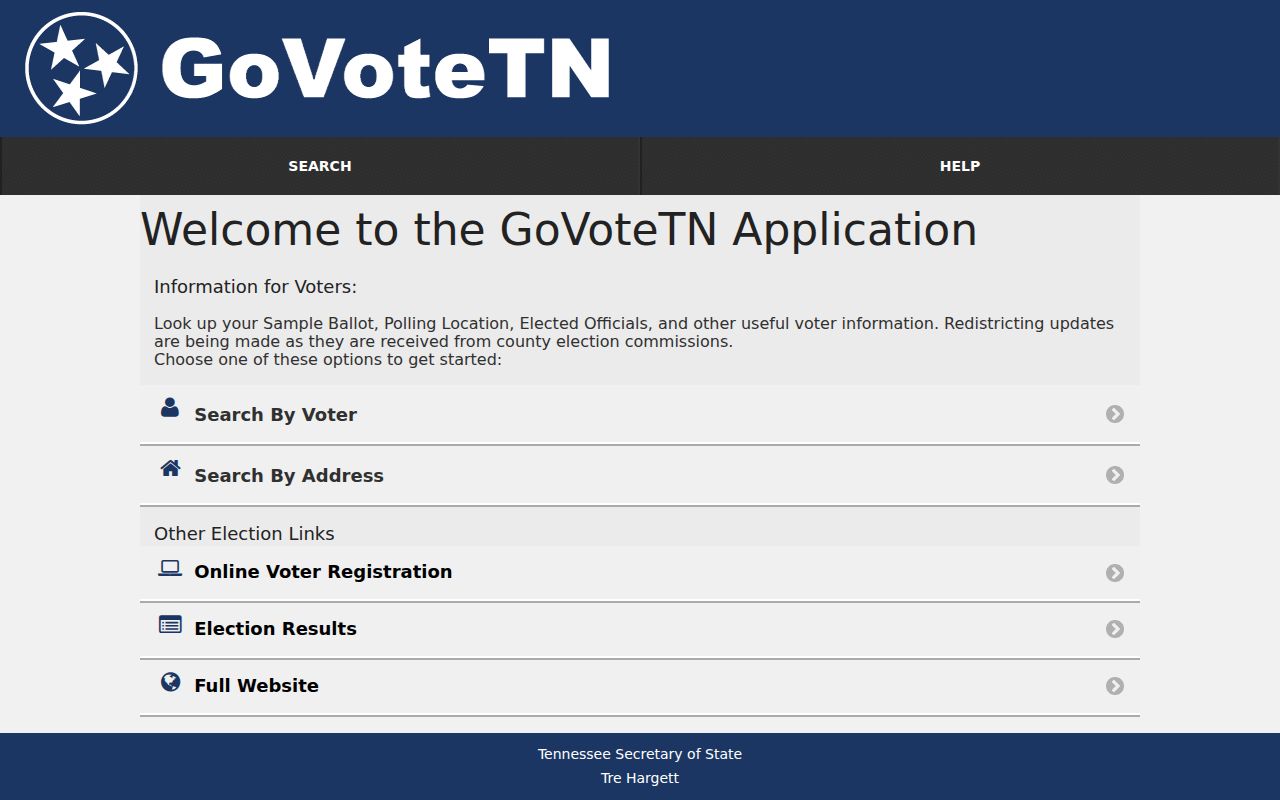
Use the county and exact-card spelling, then record only the necessary verification result and lookup date.
For the local office route, the Knox County Election Commission page identifies its official election services.
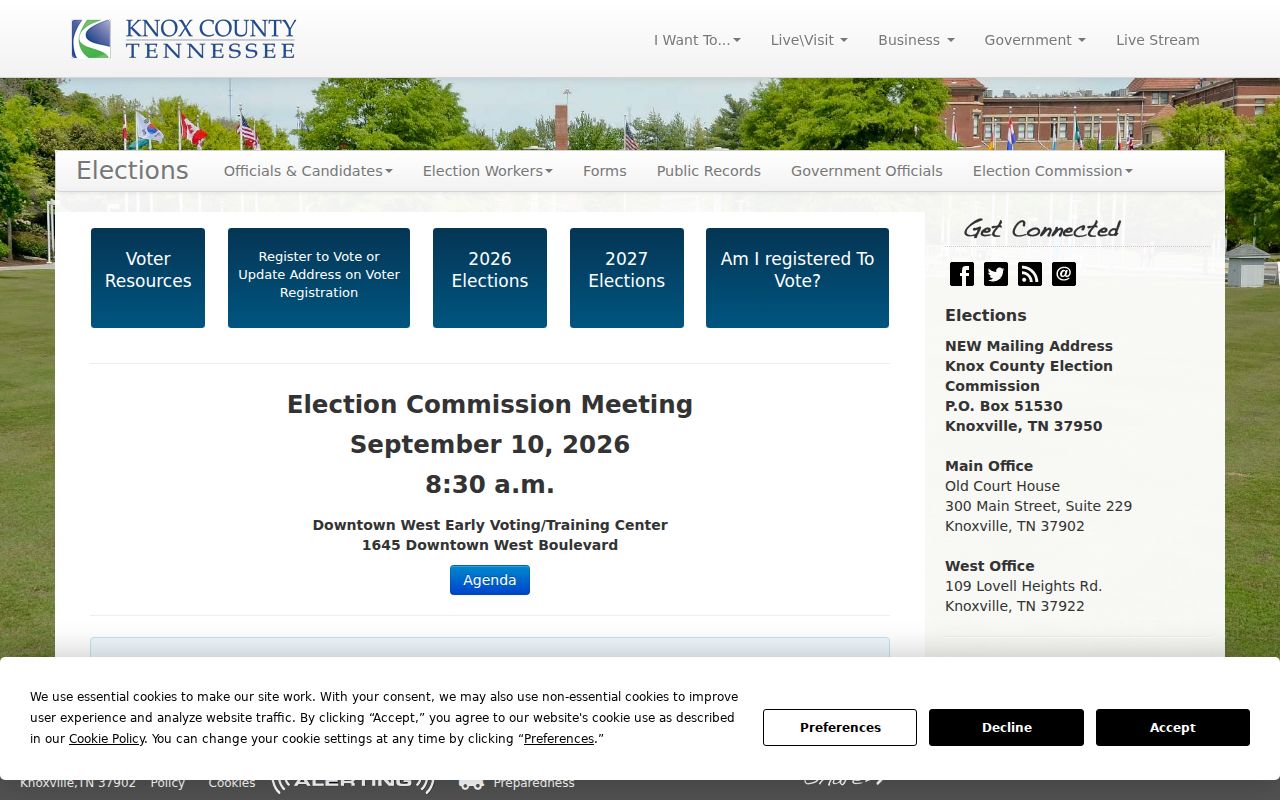
The county office is the proper place to confirm a county-specific public-record request or a registration question that the state form cannot settle.
Knoxville Vital Record Access
Vital certificates are not name directories. Tennessee Vital Records issues and maintains birth, death, marriage, and divorce certificates, and county health departments can issue statewide registered birth and death certificates. Knoxville-area applicants may start with the Knox County Health Department, but current counter hours and local payment details should be confirmed before a visit. The state applications list record-specific routes for birth, death, marriage, divorce or annulment, amendments, adoption, parentage, and other defined requests.
Under T.C.A. §68-3-205, birth records become public after 100 years. Death, marriage, divorce, and annulment records become public after 50 years. Before those periods, the applicant must meet the relationship or documented-entitlement rules and provide an acceptable identification method. The state says a signed and notarized application does not need extra ID. Recent death records also have separate limits on cause-of-death information. A no-record letter can still carry the search fee, so verify the event date and place first.
The Tennessee Vital Records applications show the official certificate routes.
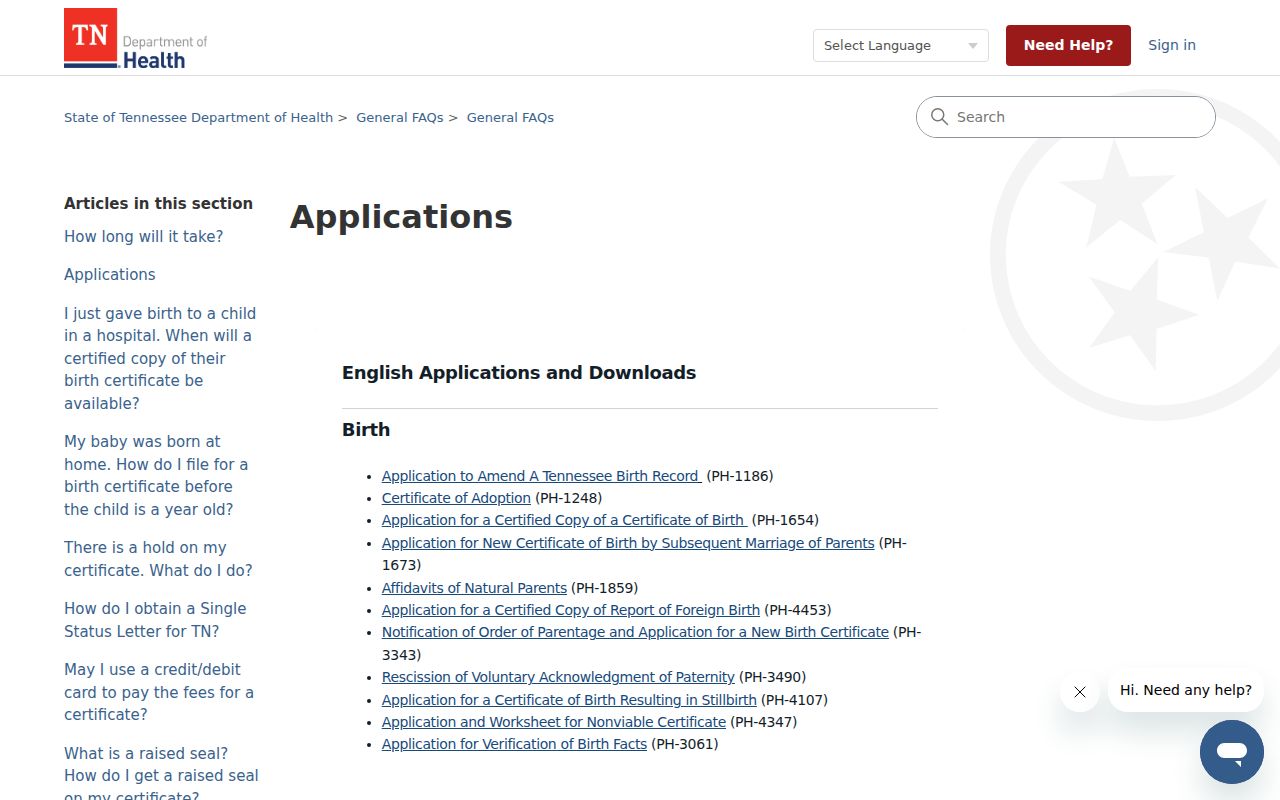
Choose the application that matches the event and use the entitlement guidance before sending identification or proof.
Note: Recent vital records can be unavailable to a researcher even when an older library reference names the same event.
Obituaries in Knoxville Records
For a historical Knoxville name search, obituaries can be a useful lead after a dated query. McClung holds newspaper microfilm for the Knoxville Journal, Knoxville News-Sentinel, Metro Pulse, and other local titles, along with subject files and clippings. An obituary may identify relatives, a community connection, a cemetery, or service details. It can also be incomplete or wrong. Cross-check it with a certificate, probate record, cemetery custodian, or contemporary notice when the distinction matters.
There is no verified single official countywide obituary database or complete cemetery index in the research. Begin with the McClung Collection or Knox County Archives, then use the relevant archive, newspaper, or cemetery custodian. Label the edition or publication date and avoid treating wording such as “of Knoxville” as a complete legal address.
Knoxville Unclaimed Property Check
A simple, low-risk name check can also include Tennessee’s official unclaimed-property route. It is useful for a person searching for their own property or an authorized estate matter, not for assembling a profile of another person. Keep claim documentation with the claimant or official process. The state route is free to search, and a matching name should be treated as a prompt to verify through the Treasury process.
The Tennessee unclaimed-property page provides the official claim-search entry point.
That search is an example of source-specific public-service navigation, not evidence of residence, identity, or entitlement by itself.
Knoxville Safety Registry Boundary
The TBI registry search is a statewide public-safety route, not a general name search. Its form allows optional name, address, city, county, ZIP, status, and offense filters, with advanced options. The official information warns that omissions and stale information can occur and says threats, intimidation, stalking, or harassment can bring legal consequences. Link to the official resource when a legitimate safety question exists rather than republishing sensitive detail from a result.
The TBI registry search interface is shown here for its official access controls.
Do not copy addresses, identification numbers, family details, or other sensitive information from a public-safety result into a research note.
Knoxville Request and No-Result Options
Tennessee Public Records Act access is a route to existing public records, not a promise that every person-linked file is open or that an agency will compile a new list. Under T.C.A. §10-7-503, Tennessee citizens may request inspection in person, by phone, mail, email, fax, or online. A custodian can require a written form for copies. Inspection is free, while copies and eligible labor can be charged under agency policy. The custodian should respond promptly or within seven business days with access, a time or cost estimate, or a denial and explanation.
When no result appears, search an alternate spelling, initials, a different court division, a surrounding date range, or the correct jurisdiction. Then ask the custodian for a defined existing record, using the name variant, record type, date span, number, and preferred inspection or copy format. Do not ask staff to infer a location, bypass a confidentiality rule, or construct an answer from unrelated files. The Open Records Counsel FAQ explains the practical statewide process.
Knoxville Resident Lookup Boundaries
Public access is record-specific. Juvenile, sealed, expunged, adoption, vital, protected-address, medical, financial, military-discharge, and motor-vehicle information can be closed or redacted. Tennessee Safe at Home gives qualifying participants a substitute address for government, legal, and mail use. An absent address or name can reflect that protection. Do not attempt to derive the actual location from other sources. The Driver’s Privacy Protection Act also limits personal motor-vehicle information.
Lawful use. Use Knoxville resident lookup sources for personal, civic, historical, estate, or record-navigation purposes. Tennessee law prohibits stalking, harassment, and unwanted contact, so omit unnecessary address, date-of-birth, identification, and family details.
Correct an index, map, court, or certificate issue with the custodian that maintains it. The Tennessee Safe at Home program is the official confidentiality resource for qualifying participants. For a historical name that needs context instead of a current address, the Knoxville city directories provide the dated collection route.