
Knoxville Previous Residents Sources
Previous residents research begins by choosing the source that fits the era. A recorded deed documents a property transaction, not necessarily a household. A criss-cross directory or city directory can place a historical listing at an address. County archive, map, obituary, and census holdings fill different gaps. Knoxville has unusually deep local history shelves, but every result needs an edition year, record role, and repository. Start with the most recent known address form, then preserve older names and numbers as separate search terms.
| Source | Years it covers | Where held | What it shows |
|---|---|---|---|
| Register of Deeds instruments | Earliest records reach the late 1700s | Knox County Register of Deeds | Recorded parties, legal descriptions, document types, and recording details |
| County Clerk deed and mortgage index | Back to 1966 in eCCLIX scans/indexes | Knox County Clerk, eCCLIX, or office index | Deed and mortgage access with other listed legal-record categories |
| Knoxville city directories | 1859 to the present | Calvin M. McClung Historical Collection | Dated household, address, role, telephone, and street-guide entries |
| County archives | Earliest holdings date to 1792 | Knox County Archives | Permanent land, tax, probate, court, marriage, and county records |
| Knoxville Sanborn maps | 1884, 1890, 1903, 1917, and 1922 | UT Libraries digital collection | Building footprint, mapped use, materials, and address context |
For a later Knoxville address, begin with KGIS and assessment context, then follow the legal instrument. For an earlier one, begin with McClung’s directory edition or an archive reference, then move forward or backward through adjacent years. A no-result can reflect spelling, a changed number, a former town, a missing scan, or a restricted record. It is not proof that no one lived there.
Note: Use the source date with every Knoxville address result, because historical editions and live property tools answer questions from different times.
Knoxville Previous Deed Trail
The Knox County Register of Deeds is the legal real-property recording office. It records deeds, deeds of trust, releases, liens, powers of attorney, plats, and other statutory documents. Its index is based on names, legal descriptions, and recording details. That makes it a strong next step after locating a current Knoxville parcel, but it is not an address-based resident list or a legal title opinion. The Register warns that some liens can be found in court or Secretary of State records and that easements may not be easy to locate in a single index.
The Knox County Clerk legal-records page documents another access channel. It says most instrument filings from January 2004 forward are online and that eCCLIX indexes and scans deeds and mortgages back to 1966. When online images or account access do not answer the question, the county office index and images are the documented fallback. Ask for a specific existing instrument, book, page, or date range rather than a general history of a person.
Start a Knoxville past-residents trail with names and document roles exactly as indexed. A trust, estate, business, attorney, or fiduciary may be central to the instrument and still say nothing about a household at the site.
Trace Knoxville Previous Residents
The deed chain moves backward from a documented transfer. Use a parcel and legal description to avoid confusing similar street names or changed numbers. A legal description often remains more stable than an address, particularly in Knoxville areas shaped by annexation and renumbering. At each step, retain the instrument type, recording date, parties as indexed, and a book, page, or instrument number when the source provides one.
- Locate the current Knoxville site address and parcel in KGIS, then compare the parcel and owner label in the assessment record. Keep site and mailing addresses separate.
- Search the recorded instrument for the current grantee or owner label, using the approximate recording date and legal description to narrow the result.
- Record the grantor, grantee, document type, recording reference, and parcel connection. Read the party role before treating a name as a past resident lead.
- Search the seller or prior grantee as a grantee to identify an earlier acquisition, then repeat the same source-by-source check backward.
- When the web route stops, use the Register or County Clerk office index, certified-copy route, or archive holdings. Do not fill a gap with an assumption.
- Grantor / grantee
- The grantor transfers an interest in a document; the grantee receives it. Neither label alone establishes residence.
- Chain of title
- A sequence of property-transfer instruments traced through recorded parties and legal descriptions.
- Legal description
- The lot, block, survey, or other formal land description in an instrument, often more durable than an old street number.
- Criss-cross directory
- A reverse directory arranged by address, useful for a historical household listing.
For a full named-street parcel walkthrough, the Knoxville by-street records page keeps the modern KGIS, assessor, and permit path distinct from this backward address trail.
Knoxville Previous Directory Pairing
Ownership is only one thread. The Calvin M. McClung Historical Collection reports complete Knoxville city directories from 1859 to the present, a telephone-directory run from 1898 forward, more than 25,000 rolls of census, government, and newspaper microfilm, plus maps and genealogy files. Directory entries can combine a name, address, household indicator, business affiliation, occupation abbreviation, telephone information in later years, and a street guide. The details vary by edition.
- Choose a directory edition closest to the Knoxville year under review and cite its year and page.
- Search the address in a criss-cross or street guide when available, then capture the listed name exactly as printed.
- Open a second nearby directory edition to test whether the address, spelling, or household listing changed.
- Pair the dated directory evidence with a census schedule available for that period through McClung research materials, preserving the edition, reel, page, or archive reference.
- Use obituaries, probate, newspaper notices, and recorded instruments only after comparing dates, names, and the address history.
A Knoxville directory listing is historical evidence, not an ownership conclusion. The collection holdings, publishers, and entry-reading practices are described in more depth with the Knoxville city directories.
Note: Expand abbreviations from the key inside the same directory edition, because a modern expansion can misstate an older entry.
Knoxville Past Directory Evidence
The 1926 Knoxville City Directory catalog record confirms a City Directory Company of Knoxville publication and exposes some directory abbreviations, including apartment, avenue, bookkeeper, carpenter, chauffeur, vacant, and street-guide notation. Its public preview did not provide a stable, fully readable representative person-entry page. That limitation matters: use the catalog record to identify the edition and then consult the McClung physical or archival source for a citation-ready listing.
The Google Books directory record below illustrates the catalog-level source available for this Knoxville historical directory.
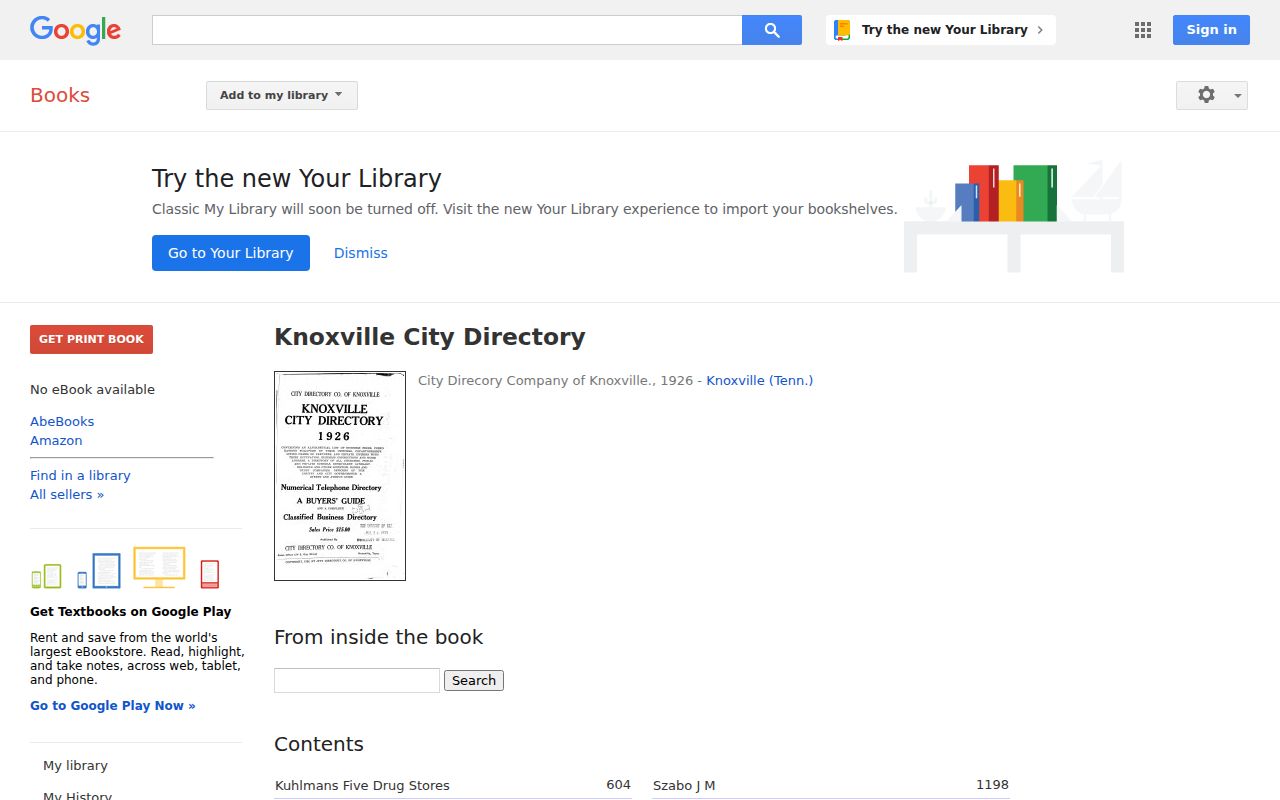
The preview helps identify a publication trail, not prove the entire contents of an unseen page. Mark any listing as a dated directory entry and compare it with an adjacent edition before connecting it to a Knoxville address history.
Knoxville Previous Address Maps
Historic maps explain the place behind a Knoxville address. UT Libraries’ Sanborn collection holds Knoxville sheets from 1884, 1890, 1903, 1917, and 1922. Sanborn sheets show a building’s footprint, materials, mapped use, and street address in that edition. They do not establish who lived there or who owns it now. Compare a dated sheet with current KGIS only for geographic orientation.
McClung’s pre-urban-renewal interactive map is a Knoxville-specific example. It links 1953 city-directory occupant information to Riverfront-Willow Street and Mountain View project boundaries. Treat that information as historical and boundary-specific. Demolition, renumbering, and parcel changes can break a direct comparison with a present address.
Fort Sanders adds another caution. It was incorporated as West Knoxville in 1888, annexed in 1897, and later renumbered to match the city pattern. Search the historic street name, former number, and neighborhood along with the current Knoxville form.
Knoxville Past Obituary Endpoints
Obituaries and probate can help close a historical Knoxville household trail, but they should be used as secondary evidence. McClung provides local newspaper microfilm, including Knoxville Journal, Knoxville News-Sentinel, and Metro Pulse, along with clippings and newspaper access. An obituary may name relatives, a place of residence, a church or cemetery, and service dates. It may also be wrong or incomplete. Confirm a material claim with a certificate, probate record, cemetery custodian, or contemporaneous notice where available.
Recent Tennessee death certificates are controlled records. Death records become public after 50 years under T.C.A. §68-3-205. Before that period, the Tennessee entitlement guidance limits access to eligible relationships and documented representatives, while cause-of-death access is narrower. Older records may be held by the Tennessee State Library and Archives. A missing current obituary or certificate does not prove a person did not live at the address.
Knox County Archives preserves permanent county records with holdings dating to 1792, including land, tax, probate, court, and marriage material. Its reading-room, phone, mail, email, and in-person research channels are the right fallback when a well-defined historic record is not online.
Knoxville Previous Records Alert
The Register’s free Knox County property-fraud alert service is a name-match notification for newly recorded documents. It can be useful after a property-research trail is established, but an alert is not proof of fraud, ownership, identity, or occupancy. The Register recommends reviewing the instrument number, recording date, legal description, and image or office record for any alert. Its June 2026 scam warning also cautioned owners about a bogus postcard demanding immediate attention.
The AlertMe registration screen below is the official Knox County source for monitoring a name match on new recordings.
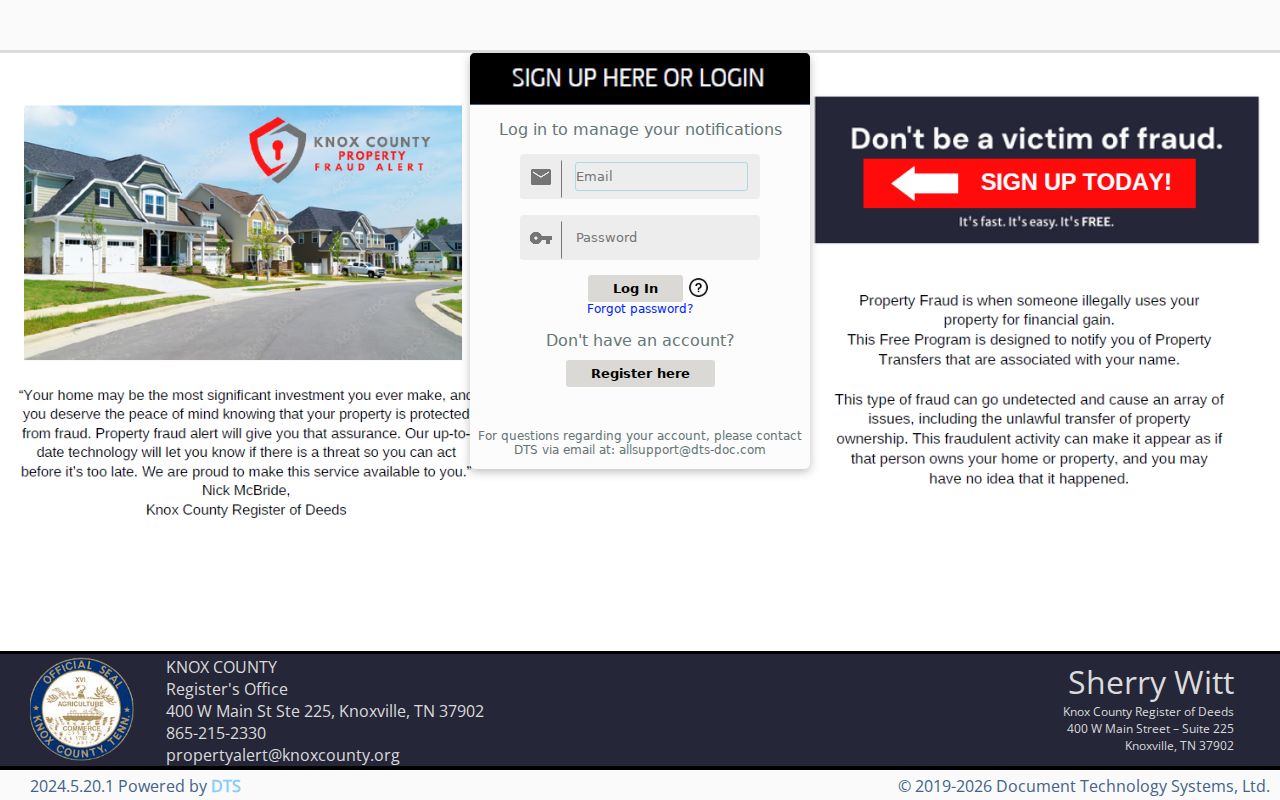
Use an alert as a prompt to inspect an official record, not as a conclusion about a household. The recorded document, its legal description, and the source date are what connect a result back to an address history.
Note: Official record notices should be verified directly with the Register instead of responding to a mailing that supplies unfamiliar contact details.
Knoxville Previous Residents Limits
Past residents research has firm limits. A directory listing may be a householder, boarder, business contact, or telephone subscriber. A deed identifies a recorded party. A parcel tool may display an owner label, a site address, and a mailing address from different data sources. A map describes a structure or geography. None should be collapsed into a present-day profile. The same name and address pair can still refer to different people at different dates.
Tennessee’s Public Records Act makes many existing records accessible, yet it does not require an office to create a new compilation. Protected addresses, Safe at Home participants, sealed records, juvenile material, sensitive vital records, and driver information have separate limits. A public result that withholds a location may be honoring a legal protection. Do not try to reconstruct it from other sources.
Lawful use. Knoxville house-history research is for family history, estate and heir work, and personal curiosity. Do not use past-resident records to track, harass, intimidate, or repeatedly contact a living person.