
Finding Knoxville Residents
Start with the kind of Knoxville record that fits what is already known. An address is best checked against the parcel map and assessor record. A recorded transaction belongs with the Register of Deeds. A historical household belongs in a dated city directory at McClung. A name in a civic record may need the Election Commission or a court clerk. Each source answers a narrow question, and its role matters. A grantee, permit applicant, neighborhood contact, and directory householder are not interchangeable labels for a Knoxville resident.
The first result is a lead, not a final identity conclusion. Knoxville records may use an old spelling, a former street number, a countywide address, or a role that is unrelated to where someone lives now. Record the source, date, jurisdiction, and identifier before comparing a second source. For current information, verify directly with the custodian. For older work, retain the edition year, book or page, and archive reference.
- Standardize a Knoxville address with USPS, then use KGIS to locate the site address and parcel ID.
- Compare the KGIS result with the assessor record, keeping the site address separate from an owner mailing address.
- For a transaction, search the Register of Deeds or the in-office index by party name, legal description, and date.
- For a past Knoxville household, check two nearby McClung city-directory editions and note each edition and page.
- Ask the named custodian for an existing record when the public screen is incomplete, and request only the public portion needed.
Knoxville Resident Record Offices
Knoxville sits in Knox County, so many useful resident records are countywide rather than city-only. The Register of Deeds holds recorded real-property instruments. The assessor supplies assessment context and property lookup. The Election Commission administers local voter records. These offices are practical starting points, but their results describe a record role, not a complete Knoxville household list. For a full address trail, use the Knoxville street directory approach after the relevant office has supplied a parcel or record number.
Knox County Register of Deeds
400 Main Street, Suite 225
Knoxville, TN 37902
865-215-2330
Knox County Assessor
Property information route
Knox County, Tennessee
Use the property portal
Knox County Election Commission
300 W. Main Street, Room 229
Knoxville, TN 37902
865-215-2480
Note: The Register is generally open weekdays from 8:00 a.m. to 4:30 p.m.; confirm hours before making a Knoxville records visit.
Knoxville Parcel Record Trails
KGIS Maps is Knoxville's shared geographic layer for address, parcel, owner, place, and other searches. An address search can lead to a parcel, an owner-card report, and property-map details. Its site or situs address comes from MPC, while owner and mailing information is assessor-derived. A parcel can have more than one site address, and the map's daily snapshot can differ from current live MPC data. Those differences should be noted rather than silently reconciled.
The Tennessee Property Assessment Data interface supplies the companion assessment view. It is helpful for parcel, classification, land and improvement values, sale date, subdivision, and tax-related context. KGIS is useful for general lines, but the assessor cautions that exact boundary questions require a survey. The Register of Deeds is the next stop for a recorded instrument. A property card or deed index is not a title opinion.
See the KGIS search interface before beginning a Knoxville residents directory property trail.
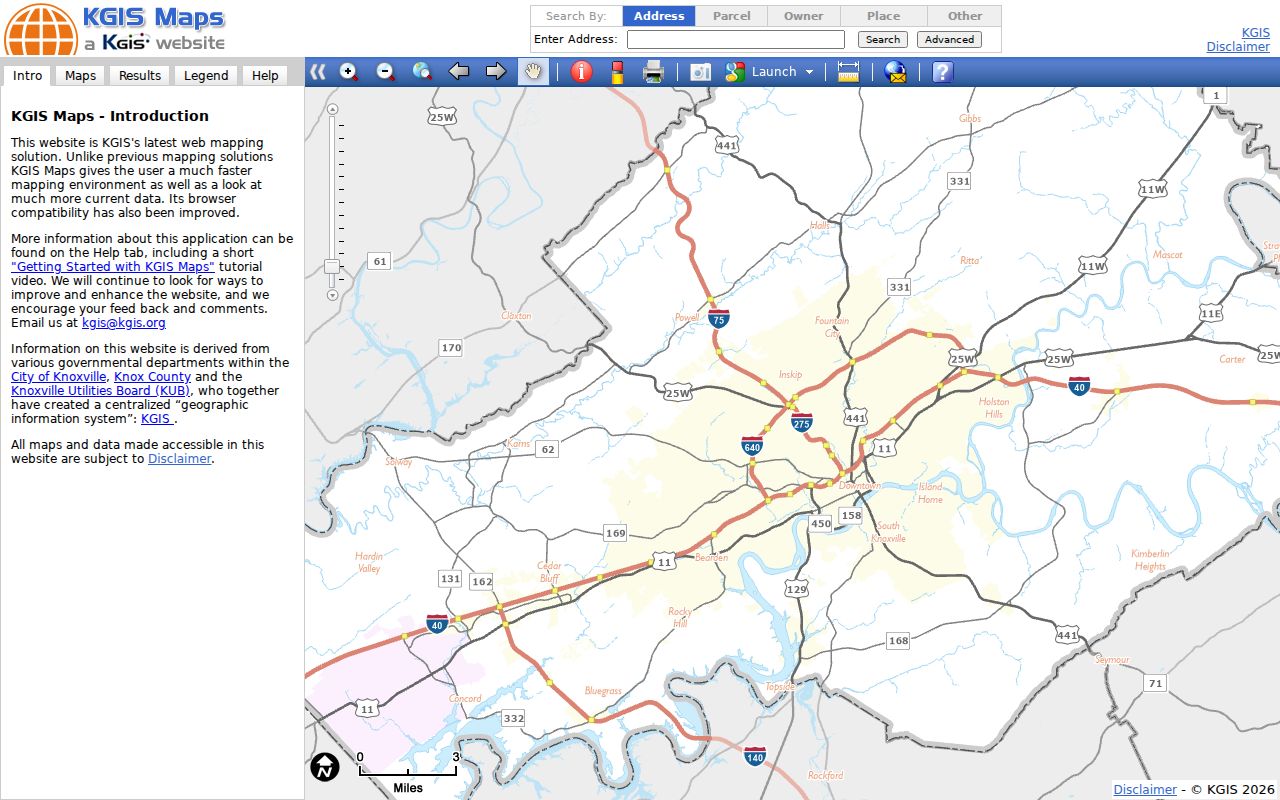
The KGIS image shows the distinct search paths that keep a Knoxville address, parcel, and owner label from being treated as the same field.
| Knoxville property field | Search type | Use | Limit |
|---|---|---|---|
| Address | Street, house number, unit, intersection | Find site location | Potential matches need review |
| Parcel | Parcel ID | Connect map and assessment | Not a resident field |
| Owner | Owner search | Find assessor label | May lag a recording |
| Legal record | Name or legal description | Find deed instrument | Index is not title advice |
Knoxville Voter Lookup Limits
The Tennessee voter lookup accepts county, first name, last name, birth month, and birth year. The state says a name or address search must match the registration card exactly, and Knox County supplies the local data. A returned record is a registration verification lead. It does not establish a person's present physical presence, and ballot choices are never part of the public voter-history information.
T.C.A. §2-2-138 provides for computerized precinct lists and voter-history information in qualifying counties, subject to a political-purpose certification for the statutory product. The research did not locate the current Knox request form, fee, delivery format, or final field list. The Election Commission is the correct place to ask for those current instructions. Missing results can reflect spelling, timing, protected status, or another access boundary.
The Knox County government hub is a practical way to confirm the responsible Knoxville office before a request.
The county hub is a useful Knoxville starting point when an online lookup needs an office-level confirmation.
Current Knoxville Resident Directories
No current Knoxville residents directory combines every household. The public sources below are narrower indexes with different keepers and limits. Their value lies in a clear record role: an assessed owner label, a registered voter lookup, a recorded-party name, or an optional civic-group contact. A result should always retain the source and the date checked.
| Knoxville source | Record role shown | Custodian | Access route |
|---|---|---|---|
| KGIS and assessment | Parcel and assessor owner label | KGIS / assessor | Public map and property search |
| GoVoteTN | Registration verification | Election Commission | Exact-card online lookup |
| Deed index | Grantor, grantee, and other parties | Register of Deeds | Online or office index |
| Neighborhood directory | Voluntary civic contacts | City Office of Neighborhoods | Directory and group route |
| Permit record | Project roles and address | Development Services | Public work search or request |
For one Knoxville name, the best comparison is between sources that identify compatible roles and dates. A court party field, for example, cannot turn a property record into a residence claim. The Knoxville resident lookup path handles that one-person verification problem without flattening every name match into a profile.
Use Knoxville public records for lawful personal research, civic navigation, and historical work. Do not use a record trail to stalk, harass, or harm anyone.
Knoxville Court Lookup Fields
Knoxville's court path is split by court and record type. The JIMS case-party search offers Last Name, First Name, Case Title, role filters, court selection, and opened-date filters. Circuit civil sessions use a separate Circuit Clerk eCommerce search. A party index may identify a defendant, plaintiff, attorney, or judge. It does not establish a Knoxville resident identity, and a charge or warrant is not a disposition.
For a usable Knoxville court citation, preserve the court or division, case number, indexed party name, role, opening date, document type, and status. Juvenile, sealed, expunged, protected-address, adoption, and other confidential material may be absent or redacted. Use the clerk office for coverage, image availability, certification, and any copy question. The research did not establish a complete historical coverage statement for the public JIMS view.
Open the JIMS party-search form to compare its local field controls.
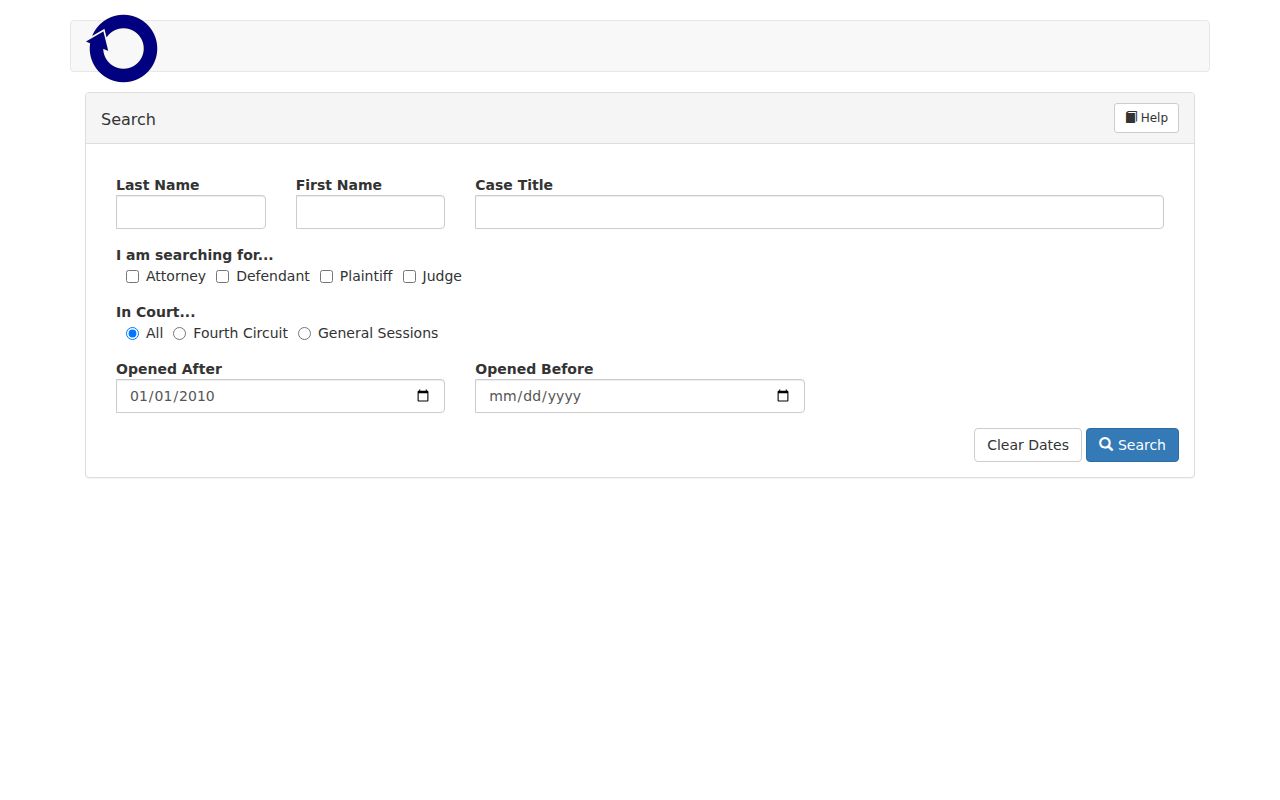
The screenshot makes clear why the Knoxville court role filter must remain attached to any name result.
Knoxville Permit Record Names
Knoxville's public work-search portal is an address-based discovery layer for permits and related records. Its detail page can show Address, Unit, Address Description, Request, Details, Type, Description, Opened, Status, and Status Date. Date and street-number ranges can be adjusted, while child and related records may connect a building permit to electrical or other work. A permit's address is a project fact, not proof that a named applicant or contractor lives there.
Development Services also provides a report-request route for full record numbers and a separate property-research form for building, zoning, or letter requests. The form describes a $50 base charge for the first hour of a building or zoning letter and warns that pre-1988 information may not be accessible. Requests should name an existing record, address, date range, and desired format. The office can estimate additional research time before it proceeds.
Review the Knoxville permit search before relying on a status label.
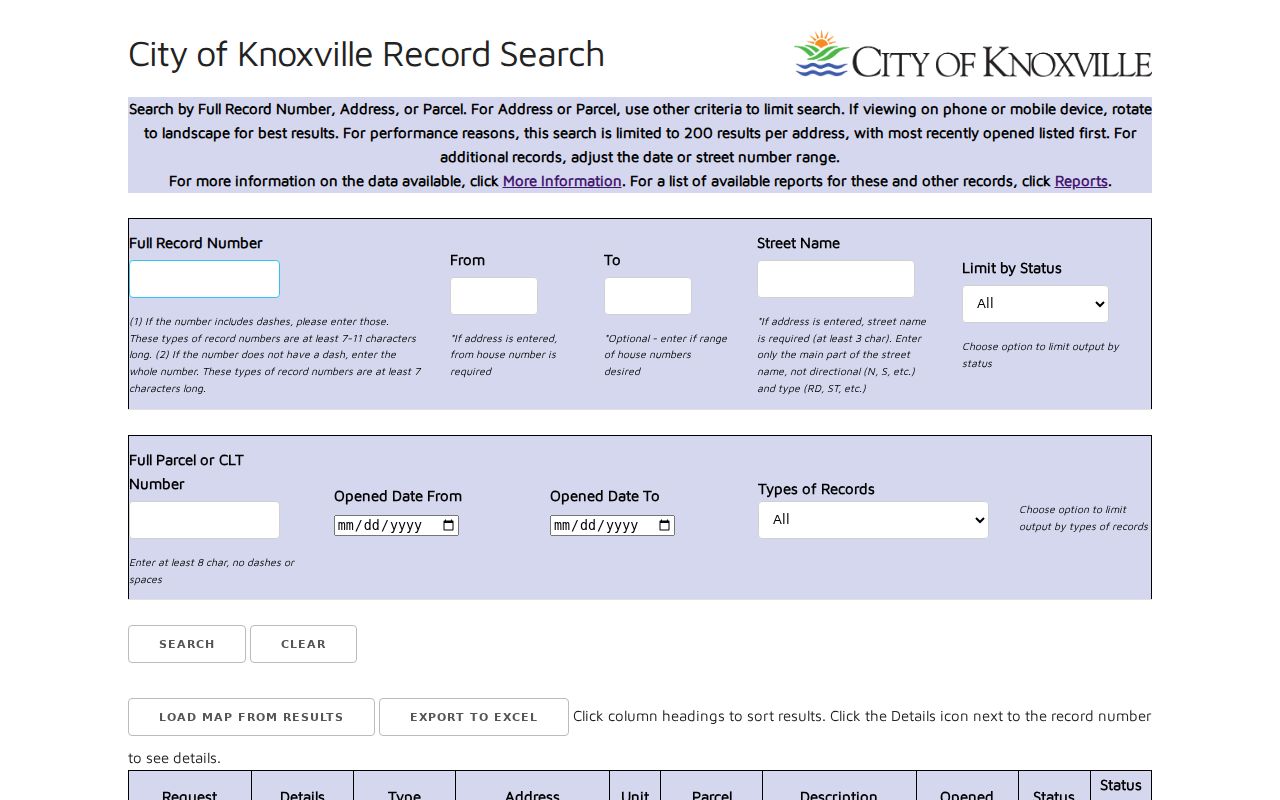
Its address and status columns help separate a Knoxville construction record from a claim about a person's current location.
Knoxville Business Record Roles
The Tennessee Secretary of State business-services hub points to entity search, annual reports, assumed names, UCC filings, copies, and certificates. Its current TNCaB route searches an entity by name or control number. A public filing can identify a legal entity, its filing date, status, and public filing roles. It does not establish that every listed officer, manager, registered agent, or mailing contact lives in Knoxville.
Business records can be a useful Knoxville historical or estate-research lead when their control number and filing date remain attached. The same limit applies to regulated credentials: the state verification service describes a status, expiration, and public discipline record, rather than a general Knoxville residence file. Ask the issuing office for a certified filing or the current credential details when the public route cannot answer the exact question.
Use the official Tennessee business-services hub for the current Knoxville filing route.

The official business interface keeps a Knoxville filing role and its entity record distinct from personal residence information.
Historic Knoxville Resident Directories
The Calvin M. McClung Historical Collection keeps complete Knoxville city directories from 1859 to the present and a Knoxville telephone-directory run beginning in 1898. Its catalog identifies City Directory Company of Knoxville volumes, Polk directories, and cross-reference material for greater Knoxville. A dated entry may provide a household name, street address, occupation or role abbreviation, spouse or household clue, business affiliation, telephone information in later editions, and a street guide. It does not prove modern ownership or present residence.
McClung is on the third floor of the East Tennessee History Center. Its collection includes more than 87,000 books, maps, genealogy files, newspaper material, and microfilm. The nearby Knox County Archives preserves non-current permanent county records beginning in 1792 and accepts researcher contact in person, by mail, email, or phone. The full shelf-and-edition method is on the Knoxville city directories page.
Open the McClung Collection record to see its Knoxville directory and research holdings.

The McClung source is the Knoxville residents directory route for a dated household trail rather than a modern person search.
Knoxville Directory Record Terms
Small labels prevent large mistakes in Knoxville research. The same name can appear in a map result, recorded instrument, city directory, permit, or court index with a different purpose. Keeping the term beside the source makes later checks possible and helps avoid a claim that the record does not support.
- Parcel
- A mapped property unit used to connect the Knoxville address, assessment data, and legal-record trail.
- Index
- A finding aid that points to a record; it may not include the full image or certified copy.
- Criss-cross directory
- An address-oriented historical directory that can help trace a dated household along a street.
- Grantor and grantee
- The parties named in a recorded transfer; neither label alone means current occupant.
Knoxville Source Role Checks
Official records and commercial lookup categories solve different problems. A custodian's map, index, or archive can show its record fields, role, date, and access limit. A commercial category may combine uncertain sources, omit the originating record, or leave a reader unable to confirm a result. Knoxville research is more reliable when the source link, record identifier, and office route are visible from the start.
| Knoxville option | Best use | What to retain |
|---|---|---|
| Official custodian | Verify an existing record | Office, date, role, identifier |
| Library or archive | Trace a historical household | Edition, reel, book, or page |
| Commercial lookup category | General lead only | Nothing without source confirmation |
Note: A Knoxville name match should remain unresolved until compatible, non-sensitive identifiers and an official source support the connection.
Knoxville Privacy Record Boundaries
The Tennessee Public Records Act, T.C.A. §10-7-503, generally opens identifiable records to Tennessee citizens, but public does not mean unrestricted. An agency may require a written form for copies even when inspection is oral, and it should respond promptly or within seven business days with access, an estimate, or an explanation. It need not create a new list or answer an open-ended research question. Name the custodian, record, date span, and copy or inspection format.
Vital, juvenile, sealed, expunged, protected-address, military-discharge, medical, tax, investigative, and motor-vehicle material carries added rules. Tennessee Safe at Home supplies substitute-address protections for qualifying participants. A missing Knoxville record can reflect confidentiality or coverage rather than a conclusion about the person. The Open Records Counsel FAQ describes the request paths and fees.
Knoxville 1953 Occupant Map
A rare Knoxville research bridge joins a dated directory to a mapped place. McClung's interactive pre-urban-renewal project uses 1953 city-directory occupant information for the Riverfront, Willow Street, and Mountain View urban-renewal boundaries. Chris DeRolph created, digitized, and georeferenced the project. The source is valuable for a historical address within that documented boundary, but it must stay labeled with its 1953 date and does not identify a current occupant.
Knoxville geography also changes across time. The 1961-62 annexation expanded the city substantially, while older Fort Sanders material can require former West Knoxville, street-number, or neighborhood variants. Pair an old entry with its edition, a Sanborn or historical map, and present-day KGIS only for modern geographic orientation. That sequence preserves the gap between a historical household record and a current parcel display.
Use the Tennessee Office of Vital Records for Knoxville-area certificate access and its current entitlement rules.
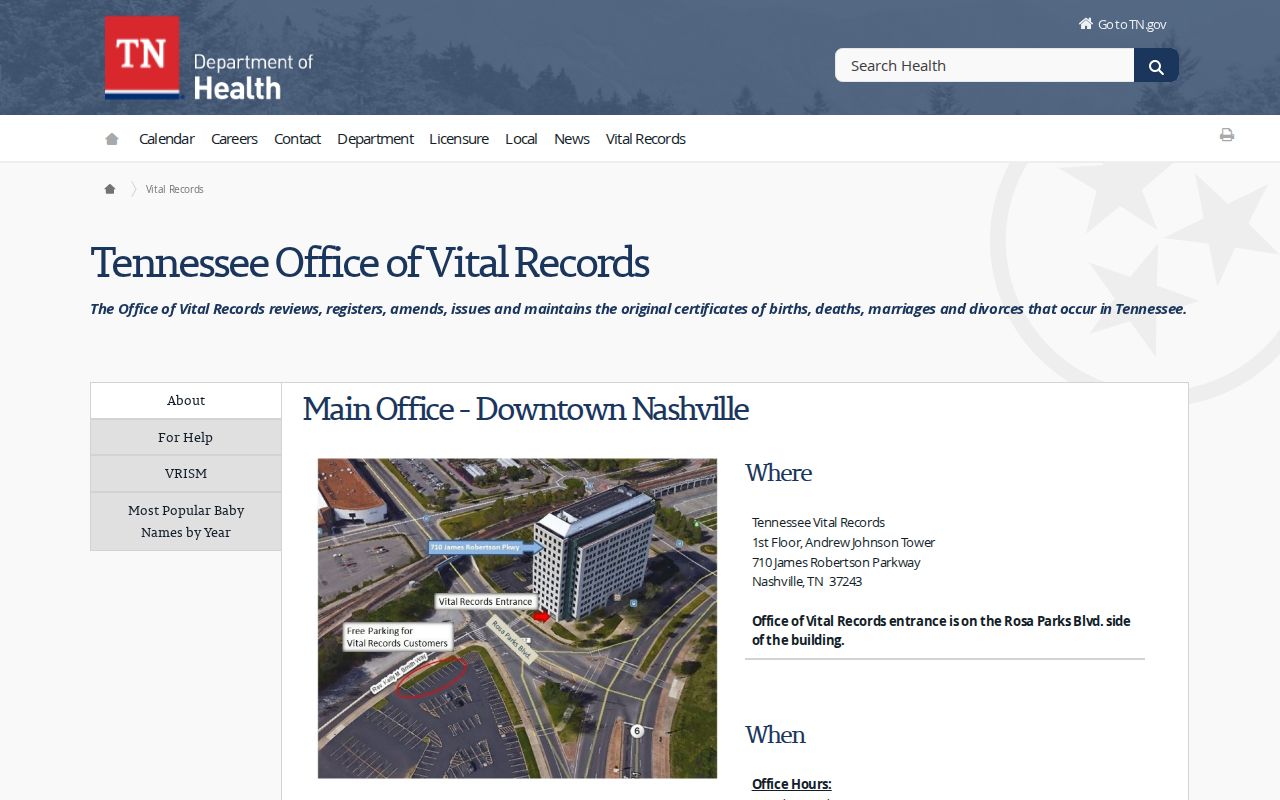
Tennessee Vital Records is another Knoxville route where source date, eligibility, and record age control what can be requested.
Knoxville Official Safety Sources
Some official Knoxville resources should be used only for their stated public purpose. The Sheriff publishes a 24-hour arrest display and directs readers to current custody routes, but it warns that its information can be incomplete, untimely, and unsuitable for legal action. A booking or warrant entry is not a conviction, and a court docket is the proper route for disposition verification. The TBI registry and custody systems likewise belong to the official safety or notification purpose, not a general directory.
Use dynamic Knoxville sources as a direct access path, never as a copied profile. Check the date, jurisdiction, record type, and source warning every time. Current details can change, and sensitive fields such as dates of birth, ID numbers, secondary addresses, and supervision information do not belong in a general reference.
Consult the Knox County Sheriff source for its live notice and official disclaimer.
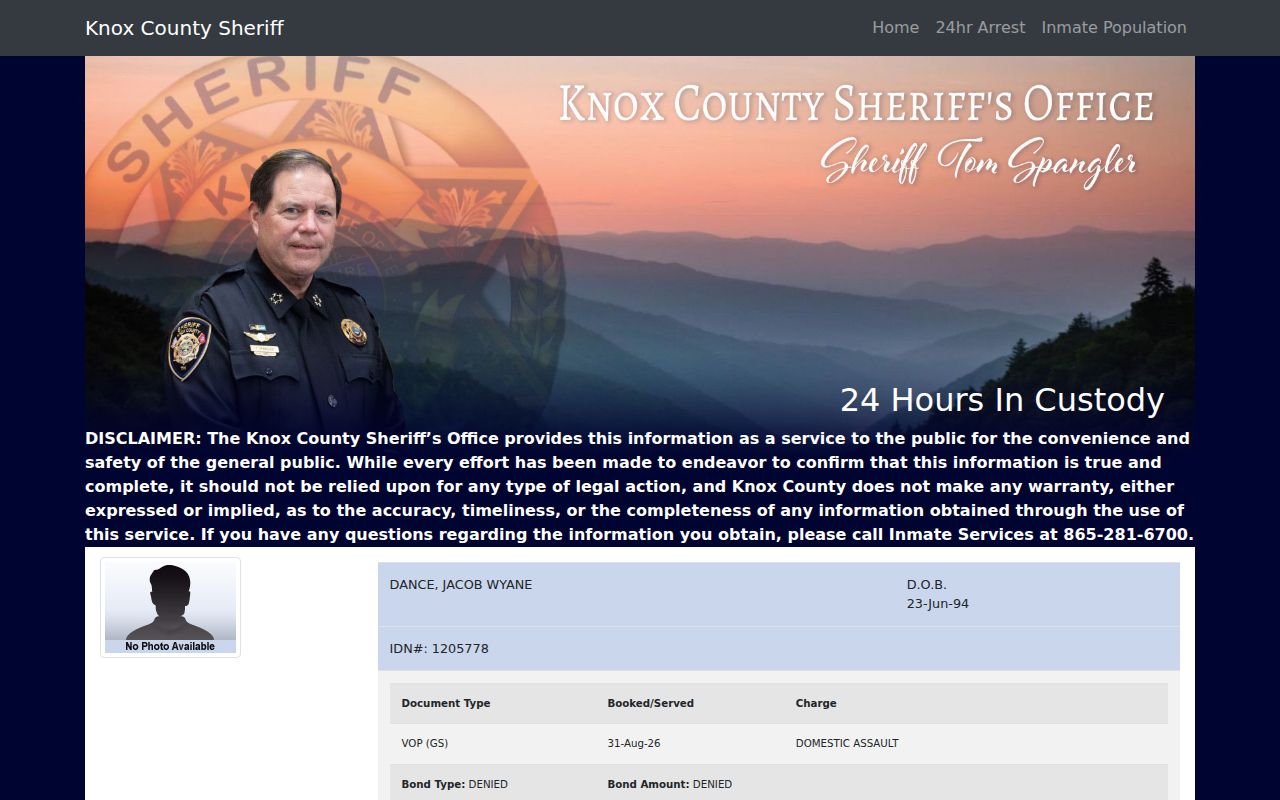
The image is a Knoxville access cue only; court and agency records are needed for any current status or disposition question.